
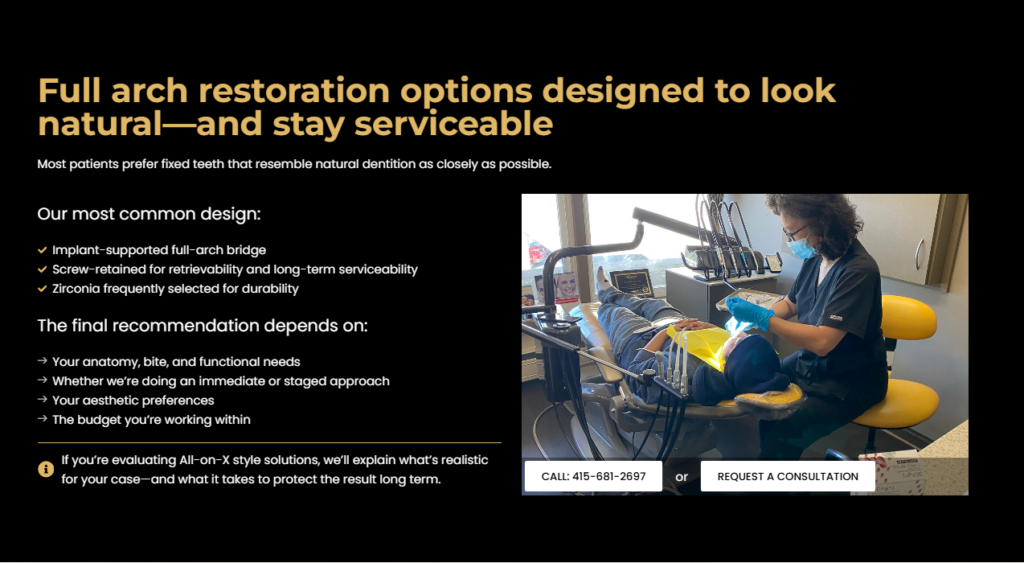
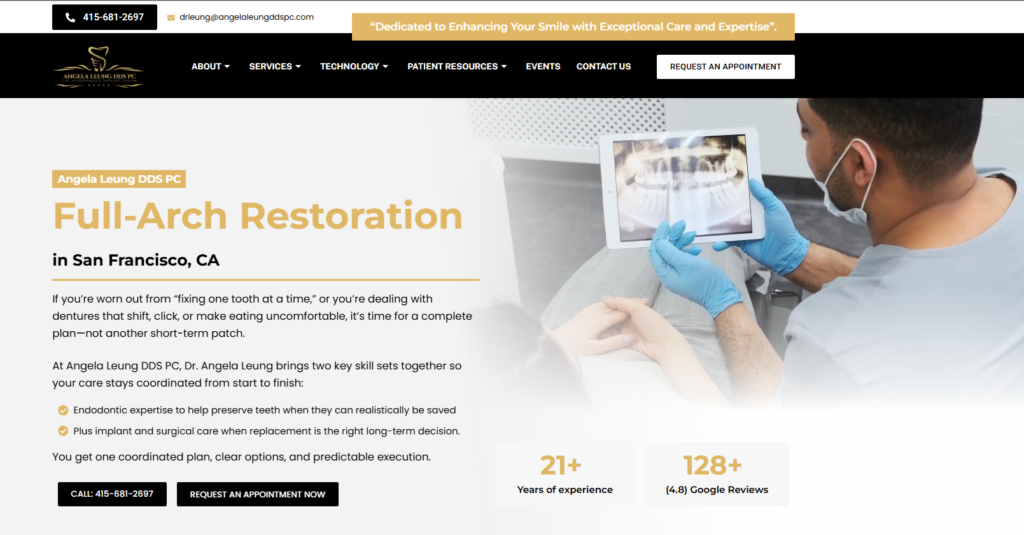
Conversion-Focused Dental Websites

Dental Web Design That Turns Visitors Into Booked Appointments

A website that looks polished but doesn’t generate calls is just an expensive digital brochure. Dental-specific web design converts visitors into patients by design, not by accident.

The Real Problem

Having a Website and Having One That Generates Patients Are Two Different Things

Dental web design determines whether visitors become patients or click away to competitors. Most dental websites look acceptable. But “acceptable” doesn’t fill the schedule.

The Core Gap

A patient searching “emergency dentist” at 10 PM decides within seconds whether to call. The website either answers their questions, builds trust, and makes booking obvious or it loses them forever.

3s

Three seconds is the window before a patient leaves and calls a competitor instead.

Why It Matters

Design built around aesthetics misses the point. Design built around patient behavior drives real appointments the kind that fill the schedule consistently.

The practices winning online aren’t necessarily spending more on marketing. They’ve simply built websites that convert the traffic they already attract.

Generic design, buried CTAs, and mobile failures are the most common — and most costly — dental website mistakes.

Common Failures

Why Most Dental Websites Underperform

Every practice needs a website. But having one and having one that generates patients are entirely different things.

01

Generic Design That Blends In

Template websites look identical across industries. Nothing signals “this is the right dentist for me.” Patients scroll past generic headlines like “Welcome to Our Practice” searching for a reason to choose this specific office.

02

Buried or Missing Calls-to-Action

Many dental websites hide phone numbers in footers, bury contact forms three clicks deep, or use vague buttons like “Learn More” when “Book Appointment” converts better. Patients who can’t find how to call leave even if they liked what they saw.

03

Mobile Experience Failures

Over 70% of dental searches happen on mobile. A site that performs poorly on phones loses the majority of potential patients before a word is read.

  1. Slow load times on cellular connections
  2. Text too small to read without zooming
  3. Buttons too close for finger taps
  4. Pop-ups that cover the entire mobile screen
  5. Forms requiring horizontal scrolling

04

No Objection Handling

Patients have concerns: cost, pain, recovery time, insurance. Websites that ignore these force patients to call with questions or find a competitor who addresses them upfront. Effective dental web design anticipates objections and resolves them before they become booking barriers.

05

Stock Photo Overload

Generic stock images signal a generic practice. Patients see the same smiling models on every dental website, building no connection or trust. Authentic imagery the actual office, real team, genuine outcomes, builds trust stock photography cannot replicate.

The Framework

The Four Jobs a Dental Website Must Do

Every element, every page, every word should serve one of these four purposes. If it doesn’t serve one of these jobs, it doesn’t belong on the page.

Job 1 — First Contact

Build Trust Within Seconds

Before reading a word, visitors form opinions based on visual design, load speed, and professional presentation. A visitor who doesn’t trust the website won’t trust the practice.

  • Professional visual design matching clinical quality expectations
  • Credentials prominently displayed degrees, certs, affiliations
  • Review integration showing real patient experiences
  • Team photography putting faces to the practice
  • Case photos demonstrating actual outcomes

Job 2 — Differentiation

Clearly Position the Practice

“Full-service family dentistry” describes every practice. Positioning communicates what makes this practice specifically right for this patient  so they stop searching and start calling.

  • Headline clarity stating who the practice serves and what it solves
  • Specialty emphasis for practices with particular strengths
  • Patient type targeting families, cosmetic patients, anxious adults
  • Geographic relevance connecting with the local community

Job 3 — Hesitation Removal

Reduce Hesitation Around Booking

Dental anxiety affects significant portions of the population. Patients also hesitate around costs, scheduling, and uncertainty. The website should resolve hesitations, not create them.

  • FAQ sections answering common concerns before they become barriers
  • Financing information addressing cost barriers directly
  • Insurance details clarifying coverage questions
  • Process explanations demystifying what appointments involve
  • Patient testimonials providing social proof at the decision moment

Job 4 — Conversion

Make the Next Step Obvious

Conversion happens when taking action requires less effort than leaving the page. Every page needs clear pathways to contact a confused visitor leaves without converting.

  • Persistent phone number in header tap-to-call on mobile
  • Multiple booking options: call, form, online scheduling
  • CTAs within content, not only at page end
  • Minimal form fields reducing friction to first contact
  • After-hours options capturing evening and weekend visitors
     

How We Build It

The Dental Web Design Process

A structured process that prioritizes strategy over aesthetics. Typical projects run 6–12 weeks from kickoff to launch, depending on complexity and content readiness.

Phase 1

Phase 1 — Foundation

Discovery and Strategy

Before designing anything, understanding the practice and its patients shapes every decision. Practice goals, patient profiles, competitive landscape, current performance, and technical requirements all inform the strategy.

Strategy Outputs

Phase 2

Phase 2 — Creation

Design and Content Development

Design and content develop together neither works without the other. Mobile-first approach, visual hierarchy guiding attention to CTAs, brand alignment, and clinically accurate procedure descriptions reviewed by Dr. Angela Leung, DDS.

Deliverables

Phase 3

Phase 3 — Build

Development and Technical Setup

Code quality and technical implementation affect everything from search rankings to conversion rates. Clean semantic HTML, performance optimization, responsive testing, schema markup, SSL, and full analytics configuration.

Technical Setup

Phase 4

Phase 4 — Growth

Launch and Optimization

Launch isn’t the finish line it’s the starting point for improvement. Full QA across devices, analytics verification, speed testing, search console submission, and redirect setup if redesigning from an existing site.

Post-Launch

Marketing Hub

Dental Web Design and Marketing Alignment

The website sits at the center of all marketing efforts. Misalignment between website capabilities and marketing activities creates friction that limits results across every channel.

The website is where all your marketing either converts or collapses.

SEO Integration

Dental SEO success depends on website architecture. Poor structure limits ranking potential regardless of content quality.

Paid Advertising Support

Google Ads drive traffic the website determines whether that traffic converts. Poor websites waste ad budget.

Google Business Profile

GBP drives significant local traffic. High-intent patients from Maps must land on a page built to convert immediately.

Reputation Display

Reputation investment pays off only when reviews reach patients at decision points across the conversion journey.

Practice Fit

Who Benefits Most From Dental Web Design Investment

Not every practice starts at the same point but every practice has the same goal: a website that converts the traffic it already attracts into booked appointments.

New Practice Launches

Starting with conversion infrastructure prevents the costly cycle of building, realizing it doesn’t work, and rebuilding from scratch.

  • Strong first impression from day one
  • SEO foundation building from launch
  • Systems capturing every early lead
  • Differentiation from established competitors

Outdated Websites

Clinical quality deserves matching digital presence. Practices with excellent care but outdated websites lose patients before demonstrating their capabilities.

  • Non-responsive desktop-only design
  • Slow loading over 3 seconds
  • Outdated trends or broken features
  • Security warnings in browsers

Ads Without Results

Traffic arriving at a non-converting website wastes advertising investment. If campaigns generate clicks but not calls, the website not the ads is usually the problem.

  • Landing page relevance to ad messaging
  • Conversion path clarity throughout
  • Page load performance on mobile
  • Trust signal presence above the fold

Specialists and Premium Practices

Implant dentists, cosmetic specialists, and high-value providers need websites that justify premium fees and attract pre-qualified patients.

  • Authority-building content and credentials
  • Case galleries demonstrating expertise
  • Patient education reducing fear barriers
  • Clear differentiation from general practices

Multi-Location Groups

Groups need brand consistency across locations while allowing local customization at scale, without the inconsistency that undermines brand authority.

  • Centralized brand management at group level
  • Location-specific content for local search
  • Consistent user experience across all locations
  • Location-level tracking and attribution

Page by Page

Dental Web Design Elements That Drive Conversions

Every page type has a different job. Each needs a specific structure built around patient psychology not design trends.

  • HOMEPAGE
  • SEVICE PAGES
  • ABOUT PAGE
  • CONTACT PAGE

Homepage Structure

The homepage serves as both front door and conversion hub. Every element must earn its place by serving one of the four conversion jobs.

  • Hero section with clear positioning and prominent CTAs above the fold
  • Services overview with links to dedicated individual service pages
  • Social proof — reviews, credentials, and professional affiliations prominently shown
  • About preview introducing the team and building personal connection
  • Location and contact information displayed prominently throughout the page
  • Trust badges — insurance logos, association memberships, recognitions
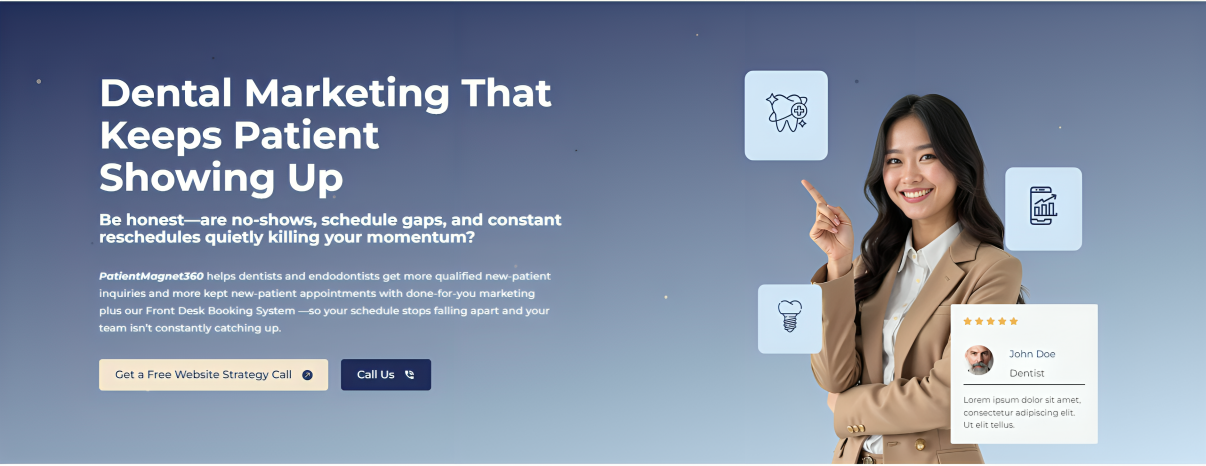
Service Pages That Convert

Each service deserves a dedicated page. Single "Services" pages listing everything convert poorly — dedicated pages rank better and convert better simultaneously.

  • Clear headline naming the service and patient benefit — not just the procedure name
  • Opening paragraph addressing patient goals and concerns directly
  • Process explanation reducing uncertainty about what to expect at appointments
  • Credential mentions establishing expertise and clinical authority
  • FAQ section handling objections before they block booking decisions
  • CTA specific to that service — not a generic "contact us" button
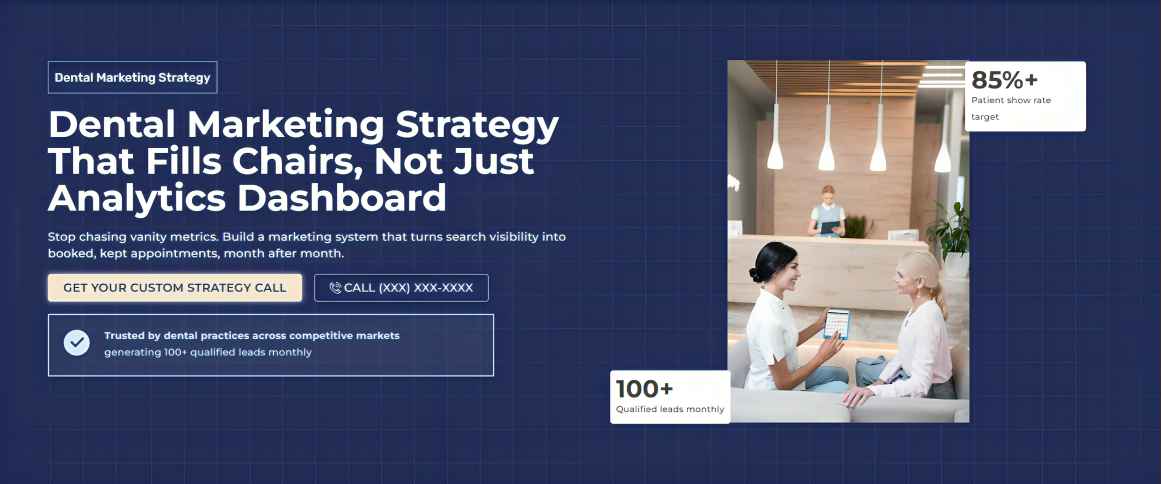
About Pages That Build Trust

About pages rank among the most-visited on dental websites. Patients want to know who will treat them — this page is where that question gets answered most powerfully.

  • Practice story — origin, philosophy, and values that resonate with patients
  • Team profiles with real photographs and complete credential listings
  • Office tour imagery showing the actual environment — no stock photos
  • Community involvement mentions building genuine local connection
  • Technology and equipment highlights positioning innovation and care quality
Contact Pages That Convert

Contact pages should minimize every barrier to reaching out. Every element should reduce friction between the patient's decision and the action that generates a new patient call.

  • Phone number prominently displayed — tap-to-call functionality on mobile
  • Address with embedded map for immediate directions access
  • Hours clearly stated including after-hours and emergency contact instructions
  • Form with minimal required fields — name, phone, and reason is sufficient
  • Alternative contact methods — email, text message, and online scheduling
Mobile-First Design

Mobile Optimization Isn’t Optional — It’s Foundational

According to Google’s documentation, mobile-first indexing means Google primarily uses the mobile version for ranking. Desktop-only optimization ignores both user behavior and search algorithm priorities.

70%+

Of all dental searches happen on mobile.

The mobile version of your website is your primary patient acquisition tool not a secondary consideration.

Touch-friendly elements — buttons large enough for finger taps with adequate spacing

Readable text — font sizes that don't require pinch-to-zoom on any device

Fast loading — optimized images, minimal code, and efficient hosting

Click-to-call — phone numbers that initiate calls directly on tap

Simplified forms — fewer fields and appropriate mobile input types

Mobile Performance Targets

Page load — cellular
Core Web Vitals (LCP)
Mobile PageSpeed
Image optimization
Under 3s
Passing
80+
Responsive

Measuring Success

Measuring Dental Web Design Performance

Website performance connects directly to practice outcomes. These metrics translate web activity into business impact.

Business Impact

New patients from website

Tracked
Call tracking

Cost per website patient

Tracked
Analytics + CRM

Revenue from website

Tracked
Practice software

Patient lifetime value

By source
Practice software

Conversion Metrics

Conversion rate

3–5%+
Calls + forms ÷ visitors

Bounce rate

Under 50%
Analytics

Pages per session

2.5+
Analytics

Call volume

Growing MoM
Call tracking

Form submissions

Growing MoM 
Form analytics

Technical Performance

Page load time

Under 3s
PageSpeed Insights

Mobile score

80+
PageSpeed Insights

Core Web Vitals

Passing
Search Console

Scope and Cost

The Investment in Dental Web Design

Website projects range dramatically in scope and cost. Understanding what drives investment helps practices make informed decisions and avoid underinvesting in their primary patient acquisition tool.

Page count and content depth required

Custom design vs. customized templates

Custom functionality requirements

Content creation — photography and copywriting

Page count and content depth required

Integration complexity — booking, portals, EHR systems

Ongoing support requirements post-launch

Investment Protection — What You Own

✓ Full ownership of all files and assets no vendor lock-in
 
✓ CMS access for content updates without technical knowledge
 
✓ Complete documentation for future development
 
✓ Performance guarantees and post-launch support terms
 
✓ Staff training included for content management

Start the Conversation

A Website Assessment Finds Exactly What’s Costing You Patients

Every visitor represents potential revenue production that either goes to the practice or to a competitor whose website performed better. A website assessment clarifies whether minor optimizations or comprehensive redesign delivers the best return.

The practices filling their schedules consistently aren’t necessarily spending more on marketing. They’ve simply built dental web design that converts the traffic they already attract into booked appointments, kept appointments, and long-term patient relationships.